Extreme Drought Hits Southern PR: 11 Municipalities at D3, Federal Emergency Requested
CoquiList · With information from Primera Hora
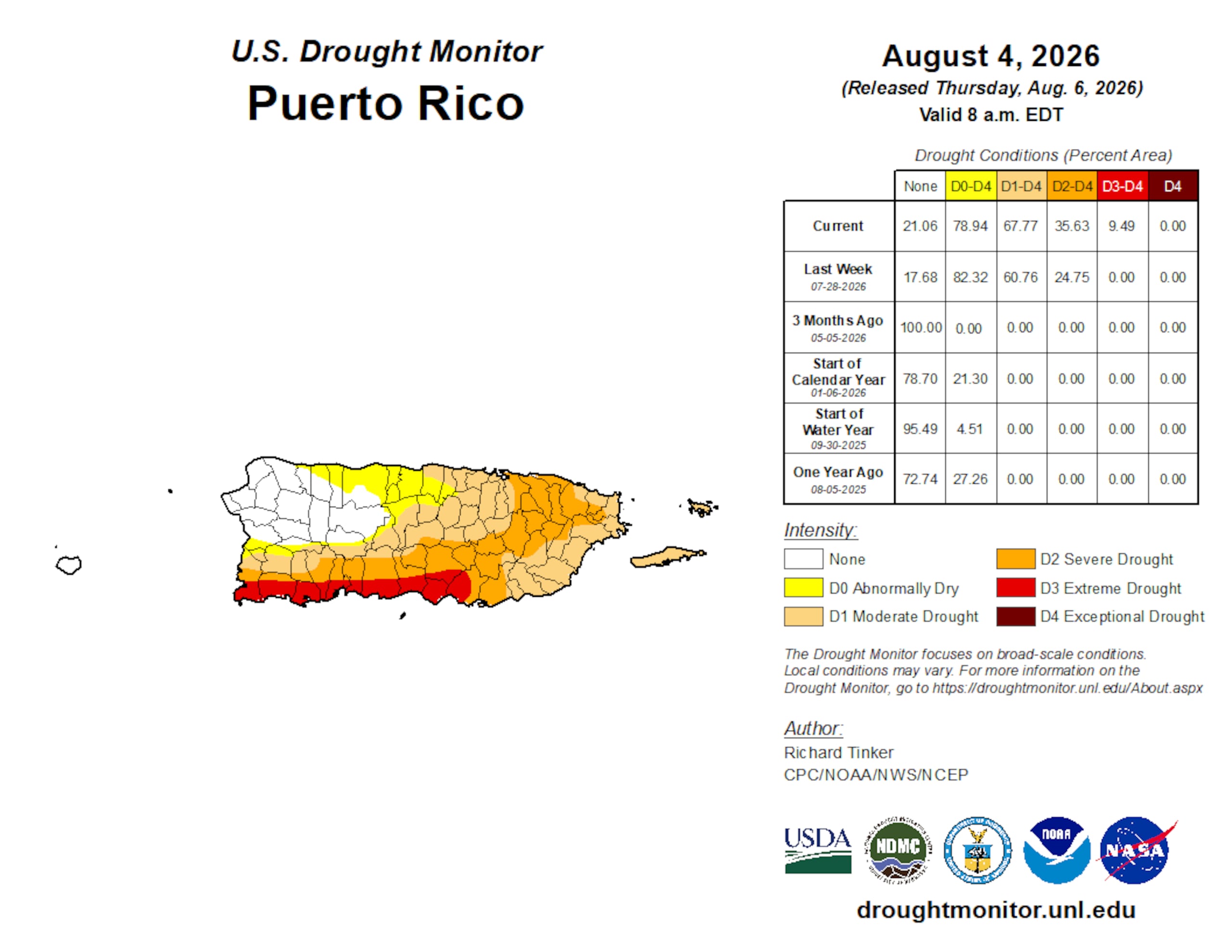
Southern Puerto Rico officially entered extreme drought this week after the U.S. Drought Monitor classified 11 coastal municipalities under category D3 -- the most severe level recorded on the island during this crisis 1. At the same time, Resident Commissioner Pablo Jose Hernandez requested a federal emergency declaration under the Stafford Act and asked the federal Department of Agriculture to issue a drought emergency designation to assist devastated farmers 2.
The August 6 Drought Monitor report revealed that 9.40% of Puerto Rico's territory is now under extreme drought (D3), while 35.63% is in severe drought (D2) -- an 11% increase in that category in just one week 1. The municipalities under D3 include the coastal zones of Cabo Rojo, Lajas, Guanica, Yauco, Guayanilla, Peñuelas, Ponce, Juana Diaz, Salinas, all of Santa Isabel, and southern Coamo 1. Additionally, the Caguas valley was added for the first time to the severe drought category.
The crisis by the numbers
The June-through-July period in San Juan accumulated only 2.06 inches of rainfall -- barely 20% of normal 1. In Jajome Alto, Cayey, just 3.15 inches fell against an average of 12.37, and in Juncos 2.20 against 12.28 1.
Across the reservoir system, 12 of the island's major reservoirs lost water this week 3. La Plata reservoir dropped 60 centimeters in a single week, sitting at 46.38 meters -- just 1.49 meters from the level that triggers operational adjustments 4. Carraizo reservoir fell to 37.53 meters and is under active rationing for approximately 183,000 subscribers 34. Dos Bocas recorded the largest daily decline at 10 centimeters 3. Only four reservoirs -- Garzas, Guayo, Loco, and Guajataca -- posted slight increases 4.
Agricultural production is in freefall. Puerto Rican coffee output has suffered a 69% decline 1. The Lake Lucchetti irrigation system has already implemented water rationing on a three-day weekly cycle 1. Pepper and fruit crops are reporting total losses across southern areas 1.
The cascading effects are already hitting institutions. The University of Puerto Rico's Rio Piedras campus postponed the start of classes to August 17 because its central cooling plant requires 250,000 gallons of water daily to serve 25 campus buildings, and its storage capacity covers only a single day 2.
The five federal measures
Resident Commissioner Hernandez presented five measures on August 8 2: request a federal emergency declaration under the Stafford Act, recommend the USDA issue a drought emergency designation, seek congressional support, include SBA individual assistance loan provisions, and initiate return of Puerto Rico National Guard members deployed in Washington, D.C.
What this means for you
If you live in any of the 11 southern municipalities classified under D3, your water supply for both consumption and irrigation is at immediate risk. Farmers face serious losses and may qualify for federal aid if the agricultural emergency designation is approved. If you are a Carraizo system subscriber -- San Juan, Carolina, Canovanas, Trujillo Alto, Gurabo -- your 48-hour zone rationing continues.
How to prepare / Checklist
- Check whether your municipality is in a D2 or D3 zone at droughtmonitor.unl.edu.
- If you are a farmer, contact your local USDA office to pre-register damages before the emergency designation is approved.
- Store drinking water -- fill clean containers during service hours. The AAA recommends at least three days' supply per household.
- Locate water distribution oasis points in your municipality through the AAA's social media or by calling 787-620-2482.
- Reduce water use to essentials: turn off unused faucets, reuse kitchen water for plants, and report leaks at 787-620-2482.
- If you are a small business owner affected, document losses with photos, invoices, and sales records for future SBA loan applications.
What comes next
Without significant rainfall, more reservoirs will cross the operational adjustment threshold -- La Plata is less than 1.5 meters from that point 4. If the Stafford Act is successfully invoked, the federal government would activate reimbursements to the AAA and municipalities for emergency expenses. The agricultural designation would allow thousands of southern farmers to access recovery funds. The Drought Monitor will update conditions again on August 13.
Sources 1 Primera Hora, "Bajo sequía extrema el sur de Puerto Rico," August 6, 2026 2 Metro PR, "Pablo Jose propone medidas para atender crisis de agua," August 8, 2026 3 Primera Hora, "Siguen bajando: 12 embalses pierden agua," August 9, 2026 4 El Nuevo Dia, "Monitoreo diario: embalse La Plata registro baja de 60 centimetros en una semana," August 9, 2026
Sources
CoquiList summary and local context. Read the linked sources for the original reporting.
Ask about this story
Ask anything about this article — in English or Spanish.
Log in to ask about this story.
Comments (0)
Log in to join the conversation.
No comments yet — be the first.