Six Pilot Whales Rescued After Mass Stranding at Punta Santiago, Humacao
CoquiList · With information from Primera Hora
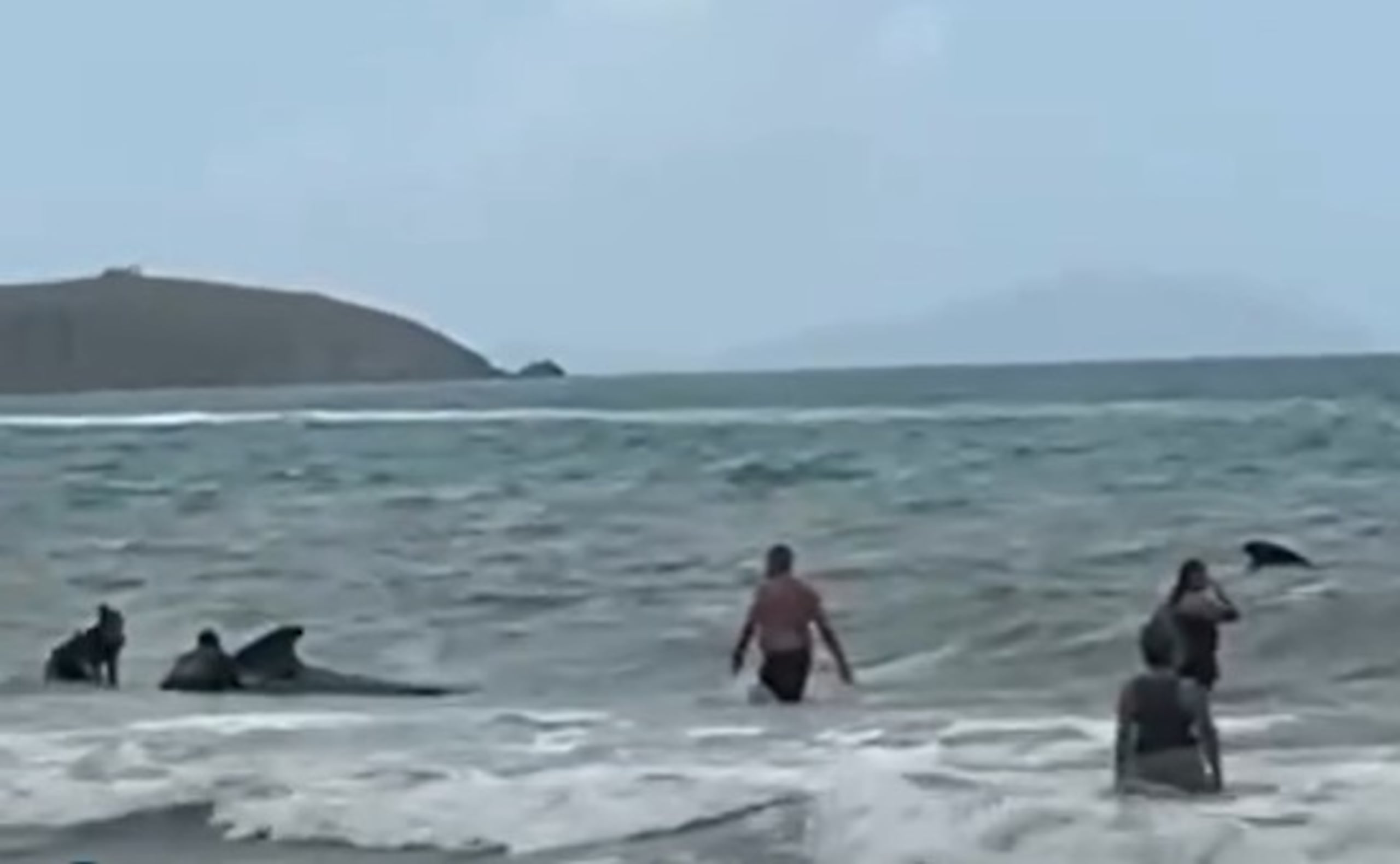
Six pilot whales became stranded in shallow waters off the coast of Punta Santiago in Humacao on Thursday, July 31, triggering a rescue operation coordinated by the Department of Natural Resources and Environmental Affairs (DRNA) that successfully redirected the animals toward deeper waters 12.
The cetaceans, each over 20 feet long and weighing approximately 1,500 pounds, were spotted by beachgoers near the Punta Santiago Vacation Center during the morning 1. Personnel from the DRNA Surveillance Corps, volunteers from the Manatee Conservation Center, and a biologist from the Humacao Natural Reserve responded to assess the animals' condition and guide them back to open ocean 2.
The operation
Grisel Rodríguez Ferrer, coordinator of the DRNA's Marine Mammal Rescue Program, directed the in-water efforts. According to Rodríguez Ferrer, rescuers managed to redirect the whales toward deeper waters, where they were observed swimming and floating normally 2. However, the coordinator warned that the danger was not over: "These strandings, when animals are sick, can cause re-beaching today or over the weekend," she explained 2.
Videos shared on social media showed volunteers and DRNA personnel in the water alongside the animals, carefully pushing them toward the sea 1. The DRNA maintained boat-based surveillance to ensure the whales continued their offshore trajectory 2.
Why pilot whales strand
Despite their name, pilot whales (genus Globicephala, meaning "round head") are not true whales but members of the family Delphinidae, related to dolphins and orcas 3. The species present in the Caribbean is the short-finned pilot whale, which inhabits tropical and warm temperate waters around Puerto Rico, the Dominican Republic, the U.S. Virgin Islands, the Bahamas, Cuba, and Jamaica, among other territories 3.
These whales live in groups of 20 to 100 individuals organized along maternal lines, where calves stay with their mothers until adulthood and males may remain in their maternal group for life 3. That tight social structure is precisely what makes them the cetacean species most prone to mass strandings across their entire range 3.
Scientists have not confirmed a single cause for these events. Theories under investigation include navigation errors into shallow water, disruptions in the geomagnetic field, and disorientation of one group member that drags the rest along due to their strong social bonds 3. Males can reach over 6 meters (21 feet) in length, with an average lifespan of 45 years, while females can live up to 60 years 1.
This is the first mass pilot whale stranding reported in Puerto Rico so far in 2026 3.
What this means for you
If you live on Puerto Rico's east coast or frequent the beaches of Humacao, Naguabo, or Yabucoa, you may encounter these whales in the coming days. Repeated strandings are common with this species, especially when a group member is sick 2. Each pilot whale weighs about 1,500 pounds and can measure over 20 feet, making a close encounter dangerous for both you and the animal 2.
Pilot whales are protected under federal law and Puerto Rico's Wildlife Law. Touching, harassing, or attempting to move them on your own can result in federal fines and endanger both your safety and the animal's 3.
What to do / Checklist
- If you spot a stranded pilot whale or one swimming near shore, maintain a minimum distance of 50 feet and do not attempt to touch or move it 2.
- Call the DRNA immediately at 787-724-5700 or dial 911 to report the sighting 2.
- Do not let pets or children approach the animal; a stressed whale can strike with its tail and cause serious injuries.
- If possible, take photos or video from a safe distance to help biologists identify the animal and assess its condition.
- Do not share the exact location on social media until the DRNA has arrived on scene; crowds of onlookers hinder rescue efforts.
- If you want to volunteer for future rescues, contact the Manatee Conservation Center or the DRNA's Marine Mammal Rescue Program.
What comes next
The DRNA is maintaining active surveillance in the waters off Punta Santiago through the weekend, given the possibility that the whales may return to the coast 2. Rodríguez Ferrer indicated that the team will continue water-based monitoring to verify the animals remain in deep water 2. If any whale shows signs of illness, it could be transported for veterinary evaluation.
The Caribbean summer season, with warmer waters and shifting currents, can alter movement patterns for these populations. Scientists continue studying the factors that contribute to mass strandings in order to develop more effective response protocols 3.
Sources
1 Primera Hora — Rescatan ballenas piloto varadas en Punta Santiago
2 El Nuevo Día — Vigilan a seis ballenas piloto tras varamiento masivo
3 El Nuevo Día — Qué son las ballenas piloto y dónde viven
Sources
CoquiList summary and local context. Read the linked sources for the original reporting.
Ask about this story
Ask anything about this article — in English or Spanish.
Log in to ask about this story.
Comments (0)
Log in to join the conversation.
No comments yet — be the first.