El Niño Threatens Puerto Rico's Reefs Just as the Worst Coral Crisis in History Was Ending
CoquiList · With information from Sociedad Ambiente Marino / NOAA
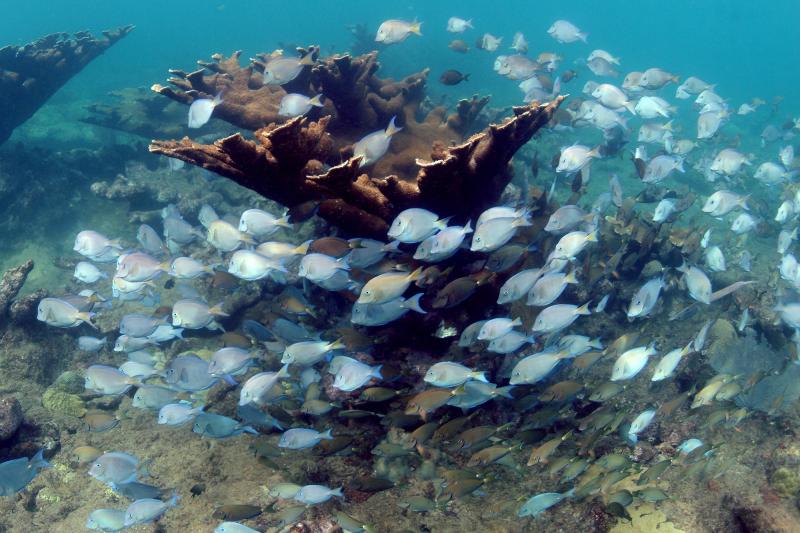
Puerto Rico's coral reefs face a new existential threat. During Coral Reef Awareness Week (July 20-26), scientists warn that El Niño -- which formed in June 2026 and has a 97% to 99% probability of persisting through winter 2026-27 1 -- could trigger a fifth global bleaching event just months after the fourth, the most devastating ever recorded, came to an end 2.
The fourth global coral bleaching event, confirmed by NOAA in April 2024, affected 84% of the planet's reefs across 83 countries and territories before concluding in mid-2025 2. The Caribbean was among the hardest-hit regions: most reef areas exceeded 16 degree heating weeks of thermal stress, and some surpassed 20 3. In Puerto Rico, Florida, and Mexico, 90% to 100% mortality was reported among Acropora corals -- the shallow-water reef-building species that once dominated the Caribbean 3.
Data from the Sociedad Ambiente Marino (SAM) confirms the scale: Puerto Rico accumulated approximately 19.1 degree heating weeks (DHW) in 2023, a record 21.3 in 2024, and 11-12 in 2025 4. For reference, the threshold for significant bleaching is just 4 DHW, and anything above 8 signals severe mortality risk 4. Three consecutive years above the limit: the reefs have had no chance to recover.
And now El Niño is here.
The perfect storm of 2026
NOAA Coral Reef Watch coordinator Derek Manzello leaves no room for ambiguity: "We are now in the era where reefs will bleach on a near-annual basis" 2. NOAA's four-month outlook shows "high risk" of bleaching for Florida and the Caribbean this summer 5. If ocean temperatures continue rising during hurricane season, the critical thermal accumulation period will run from July through October 4.
The 2026 El Niño could reach the "very strong" category, with anomalies of +2.0 degrees Celsius or higher, and is projected to peak between September and November 1. Compounding this is the severe drought gripping southern Puerto Rico -- the second driest May-July period since recordkeeping began in the 1950s 6 -- which reduces cloud cover and increases solar radiation over coastal waters.
What is at stake
Coral reefs inject $1.411 billion annually into Puerto Rico's economy 7. Approximately 75% of fish and shellfish caught by artisanal fishermen come from reef ecosystems 7. Reefs also serve as natural barriers against storm surge and coastal erosion -- protection the island desperately needs in the middle of hurricane season.
But the crisis has not left the scientific community standing idle. NOAA awarded $10.6 million to the Institute for Socio-Ecological Research (ISER) to restore six reefs in Puerto Rico by outplanting more than 124,000 micro-fragments of bleaching- and disease-resistant corals 8. The plan includes releasing 12,000 sea urchins and 6,400 crabs to control the algae that compete with corals 8. The investment has generated more than 60 direct jobs 8.
The DRNA also has a Coral Reef Restoration Action Plan for 2025-2035 targeting eight priority intervention areas, supported by 14 in-situ nurseries and two land-based nurseries 89.
What this means for you
If you live on the coast, fish, operate a maritime tourism business, or simply enjoy the ocean, reef health affects your wallet and your safety. Dead reefs mean fewer fish, beaches more vulnerable to erosion, and a decline in the diving and snorkeling tourism that sustains entire communities in Rincón, Culebra, La Parguera, and Fajardo.
But there is also something you can do right now.
How to take action / Checklist
- Report bleaching. If you see white or pale corals while diving or snorkeling, report it to the Sociedad Ambiente Marino (sampr.org) or the DRNA. Your observation feeds the monitoring network.
- Use reef-safe sunscreen. Avoid products containing oxybenzone and octinoxate, which are already banned in some Caribbean jurisdictions.
- Do not anchor on coral. Use mooring buoys when available. Illegal anchoring destroys in minutes what takes decades to grow.
- Reduce runoff. If you live near the coast, minimize fertilizer and pesticide use. Sedimentation and pollution are stressors that weaken corals before the heat arrives.
- Volunteer. Organizations like ISER, Para la Naturaleza, and Coral Restoration Foundation PR need divers and volunteers for their coral nurseries.
- Demand action from your legislators. The Coastal Law and the DRNA's 2025-2035 Restoration Plan need real funding and oversight.
What comes next
The next three months will be decisive. If El Niño reaches its projected intensity and ocean temperatures keep climbing, Puerto Rico could be part of the fifth global bleaching event -- the second in barely two years. NOAA will update its thermal stress projections in August 5. The Sociedad Ambiente Marino is planning intensive monitoring from July through October across the island's four geographic regions 4.
The question is no longer whether Puerto Rico's reefs will bleach again, but how many will survive this time.
Sources
1 Caro Santamaria Ocean, "Coral Reef Awareness Week 2026: The El Niño Year," July 2026 2 NOAA NESDIS, "World's Fourth Mass Coral Bleaching Event Likely Ended in 2025," May 2026 3 NOAA, "NOAA Confirms 4th Global Coral Bleaching Event" 4 Sociedad Ambiente Marino, "Technical Bulletin June 2026" 5 CBS News, "El Niño could bring more widespread coral bleaching, NOAA warns," June 2026 6 Drought.gov, "Drought Update for Puerto Rico and the U.S. Virgin Islands," July 23, 2026 7 Corales del Este PR / Estudios Técnicos / Sea Grant PR 8 NOAA Fisheries, "New Hope for Puerto Rico's Coral Reefs" 9 DRNA, "Puerto Rico Coral Reef Restoration Action Plan: 2025-2035"
Sources
CoquiList summary and local context. Read the linked sources for the original reporting.
Ask about this story
Ask anything about this article — in English or Spanish.
Log in to ask about this story.
Comments (0)
Log in to join the conversation.
No comments yet — be the first.