Puerto Rico's Reservoirs Climb Out of Alert as Extreme Drought Drops to 37%
CoquiList · With information from Metro Puerto Rico
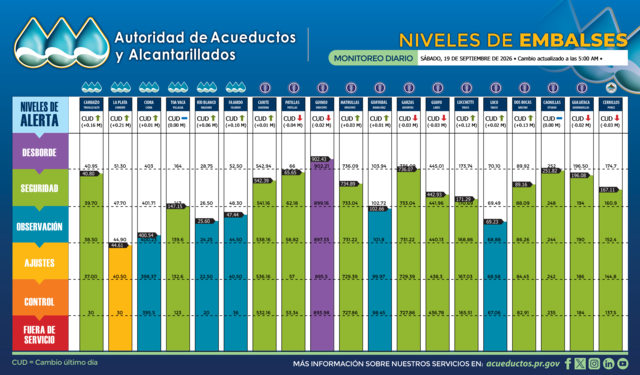
For the first time in months, all 19 reservoirs that supply drinking water to Puerto Rico have completely left alert and deficit status, according to the daily report published by the Puerto Rico Aqueduct and Sewer Authority (AAA) on Saturday, September 19, 2026 1. Seven bodies of water — including Patillas, Guineo, Garzas in Adjuntas, Caonillas, and Guajataca — are already at overflow status, while seven others, including Carite, Dos Bocas, Cerrillos, Lucchetti, Guayabal, Guayo, and Matrullas, remain at safety level 1. The Carraízo reservoir in Trujillo Alto, which supplies water to roughly 500,000 customers in the metropolitan area, reached 40.80 meters above sea level and is on the verge of hitting its own overflow threshold 12.
Background: months of crisis before the relief
The shift marks a notable turnaround from what has been a difficult summer for the island's drinking-water system. For much of 2026, several reservoirs — particularly Carraízo and La Plata — were under constant watch due to low levels, as the AAA rolled out conservation measures in the metropolitan region. The recent recovery is a direct response to rainfall generated by a pair of tropical waves that crossed the archipelago in mid-September, which dropped between 2 and 4 inches of rain in eastern municipalities and raised Carraízo's level by roughly 87 centimeters between Wednesday and Thursday of that week, according to data cited by the U.S. Drought Monitor 35. That improvement in the watersheds is now showing up in the AAA's daily report: of the 19 monitored reservoirs, 11 registered increases in the 24 hours before Saturday, six dropped slightly — Patillas had the steepest decline, just 0.04 meters — and two held steady, Toa Vaca and Caonillas 1.
The numbers you need to know
Despite the improvement in reservoir levels, drought as a regional phenomenon hasn't disappeared. The U.S. Drought Monitor reported, in its update from Thursday, September 17, that extreme drought (category D3) fell from 39.49% to 37.14% of the territory in one week, a reduction of just 2.35 percentage points 345. Severe drought (D2) actually rose slightly, from 18.29% to 20.05%, while the area completely free of drought grew from 20.36% to 26.18% 4. In total, about 2.9 million people still live in zones under some degree of drought 34. The most persistent pockets of extreme drought are concentrated in two corridors: one running through the southwest, from Cabo Rojo along the south coast to Salinas and parts of Cayey and Aibonito, and another stretching from San Juan toward the Loíza coast and curving into the south-central and eastern regions, including Vieques and Culebra 4. In other words: the reservoirs — which depend on rainfall in their specific watersheds — recovered faster than the island-wide drought index, which measures accumulated soil moisture across a much broader area.
What this means for you
If you live in the metro area served by Carraízo, you're unlikely to see new water-restriction measures in the near term, since that reservoir has moved past the alert level that triggered operational adjustments months earlier 12. But if you live in the southwest (Cabo Rojo, San Germán, Lajas, Sabana Grande, Guánica, Yauco, Guayanilla, Peñuelas, Ponce) or in the eastern corridor covering Vieques, Culebra, Naguabo, or Ceiba, your municipality remains under extreme drought according to the latest map, so water-conservation precautions are still warranted even though the large reservoirs look healthy 4. This week's improvement is a reprieve, not the end of the island's hydrological problem.
How to check / Checklist
- Check your municipality's status on the U.S. Drought Monitor map (drought.gov) before assuming the drought is over where you live.
- Review the AAA's daily reservoir-level report at acueductos.pr.gov if your water supply depends on Carraízo, La Plata, or Guajataca, since levels change daily with rainfall.
- Keep up water-conservation habits (short showers, fixing leaks, watering plants early in the morning) even if your area has come off alert status, because the rain pattern can reverse quickly during dry weeks.
- If your municipality is on the extreme-drought list, avoid lawn irrigation and hose-based car washing during peak consumption hours.
- Follow the AAA's social media alerts to find out immediately if a reservoir in your region slips back into alert status.
What's next
Meteorologists warn that additional, sustained rainfall will be needed for the improvement to reach the extreme-drought zones in the northeast and south-central regions, which don't directly benefit from the Carraízo or La Plata watersheds 35. The AAA will keep publishing its daily level report, and the U.S. Drought Monitor updates its map every Thursday, so the next reading, expected September 24, will show whether the recovery trend holds or whether the island slides back into a drier pattern heading into the final stretch of hurricane season.
Fuentes: 1 Metro Puerto Rico 2 NotiCel 3 Metro Puerto Rico 4 El Nuevo Día 5 Infobae
Sources
CoquiList summary and local context. Read the linked sources for the original reporting.
Ask about this story
Ask anything about this article — in English or Spanish.
Log in to ask about this story.
Comments (0)
Log in to join the conversation.
No comments yet — be the first.